
Go To Market UX • Design for Velocity • De-risking UI
Mapping the Path to Scalable Activation
Using user journeys to identify risks and map out pain points that block activation/retention in the early user lifecycle.
The challenge
As part of Its growth strategy, the company identified accounting agencies as one of the most aligned targets. They would use our product to provide a new service to their customers who would never directly interact with it, only see its artifacts as deliverables from the agency.
This was a very different use case from what the product had been initially designed for, and we needed to map out the user journey to give us a bird’s eye view of the early lifecycle (Initial Value Phase) and to uncover potential risks and opportunities before we started actively selling.
This was a combination of software, sales and training, and an important coordinated effort: marketing was doing the ground work for an effective onboarding, support was in charge of training our accountant users, and sales needed to get a good understanding of the solution to effectively go out and get accounting agencies excited by our solution.
The approach
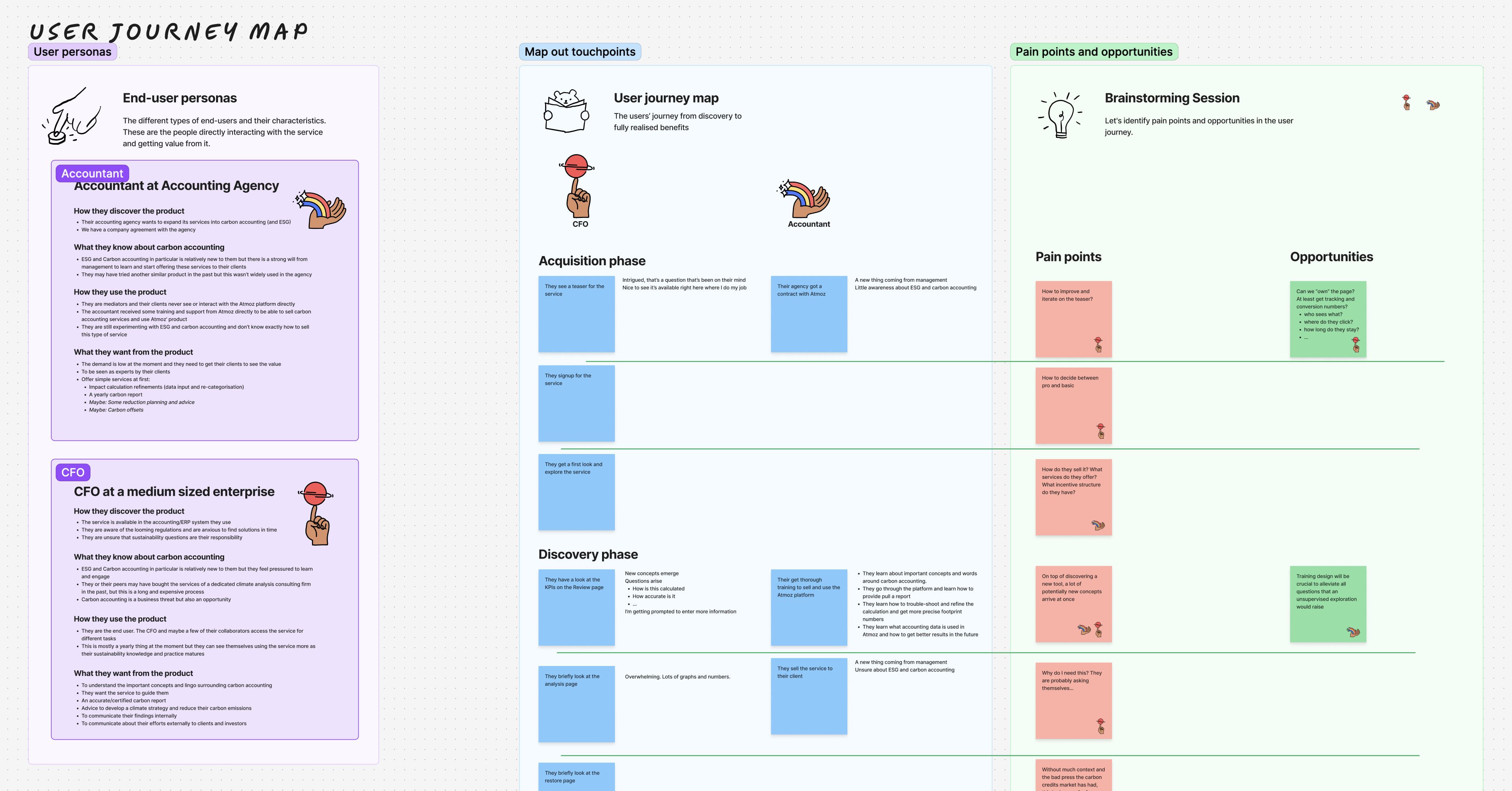
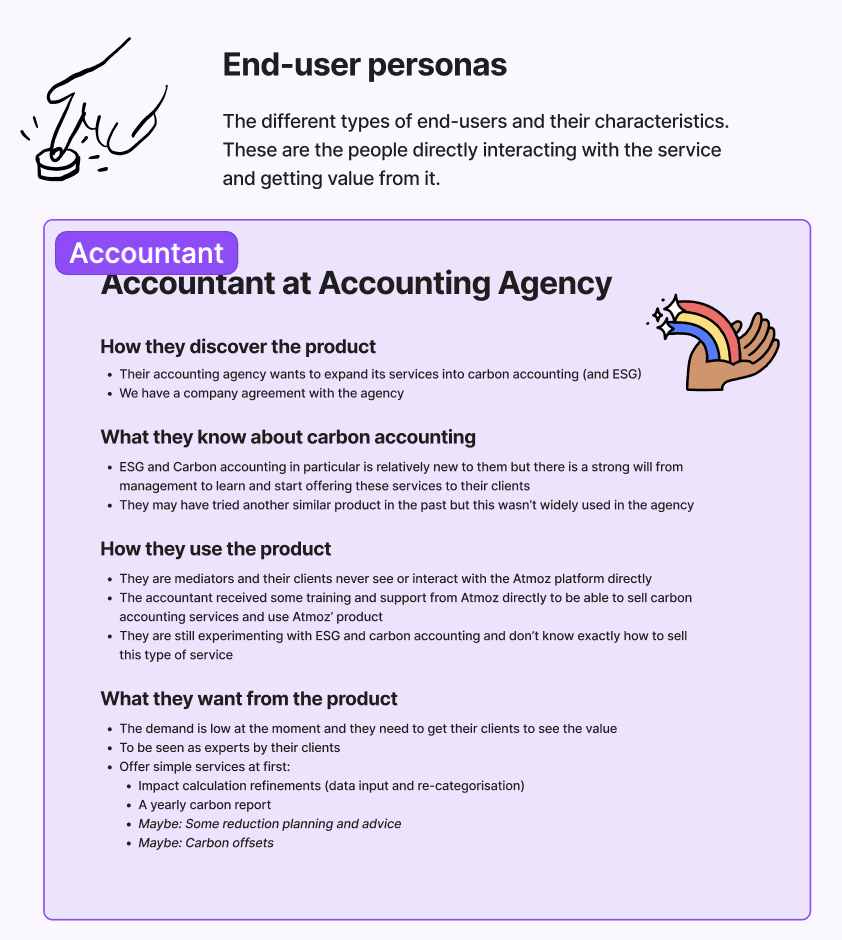
To begin with, I reformulated the user personas from a Value Proposition Canvas format into a more narrative form that better described their attitudes and goals, with our product specifically. This made it easier to walk through each step in the journey with a clear picture of the target user.
While I do believe that there is a place for well researched and designed "traditional" personas, in a resource-constrained startup environment I favor Jobs To Be Done and Value Proposition Canvas types of user archetypes because they focus on why people hire the product (value/business drivers) rather than simply who they are (attributes).
The User Journey Map allowed us to identify difficult spots in the onboarding: the startup faced a scaling barrier in its Go-to-Market strategy. While the product had value, the complex, multi-touchpoint rollout to this new client type was proving unscalable and resource-intensive, blocking the path to true Product-Market Fit.
To achieve rapid, repeatable deployment across numerous agencies with minimal intervention from our internal team, we leveraged this user journey mapping and personas to finely analyze the existing client deployment and experience. This process allowed us to precisely break down our onboarding and training into specific, repeatable steps. We identified the exact questions to address and the specific training modules (documentation, webinars, etc.) that needed to be created to enable self-serve deployment and scale.
The impact
Crucially, the journey mapping unearthed a significant structural risk that we immediately turned into our biggest growth opportunity. The necessary involvement of the client (the agency) meant that one of our core monetization levers was now controlled by a third party. They became the gatekeepers to the end-user. We recognized that this risk could be transformed into an asset: by defining proper training and incentives, we could empower these clients to become advocates of that particular service and effectively sell it for us. The UX work didn't just improve an onboarding screen. It identified a scaling flaw, mitigated the associated financial risk, and provided the blueprint for a scalable B2B distribution channel and the resources necessary for deployment at scale.